
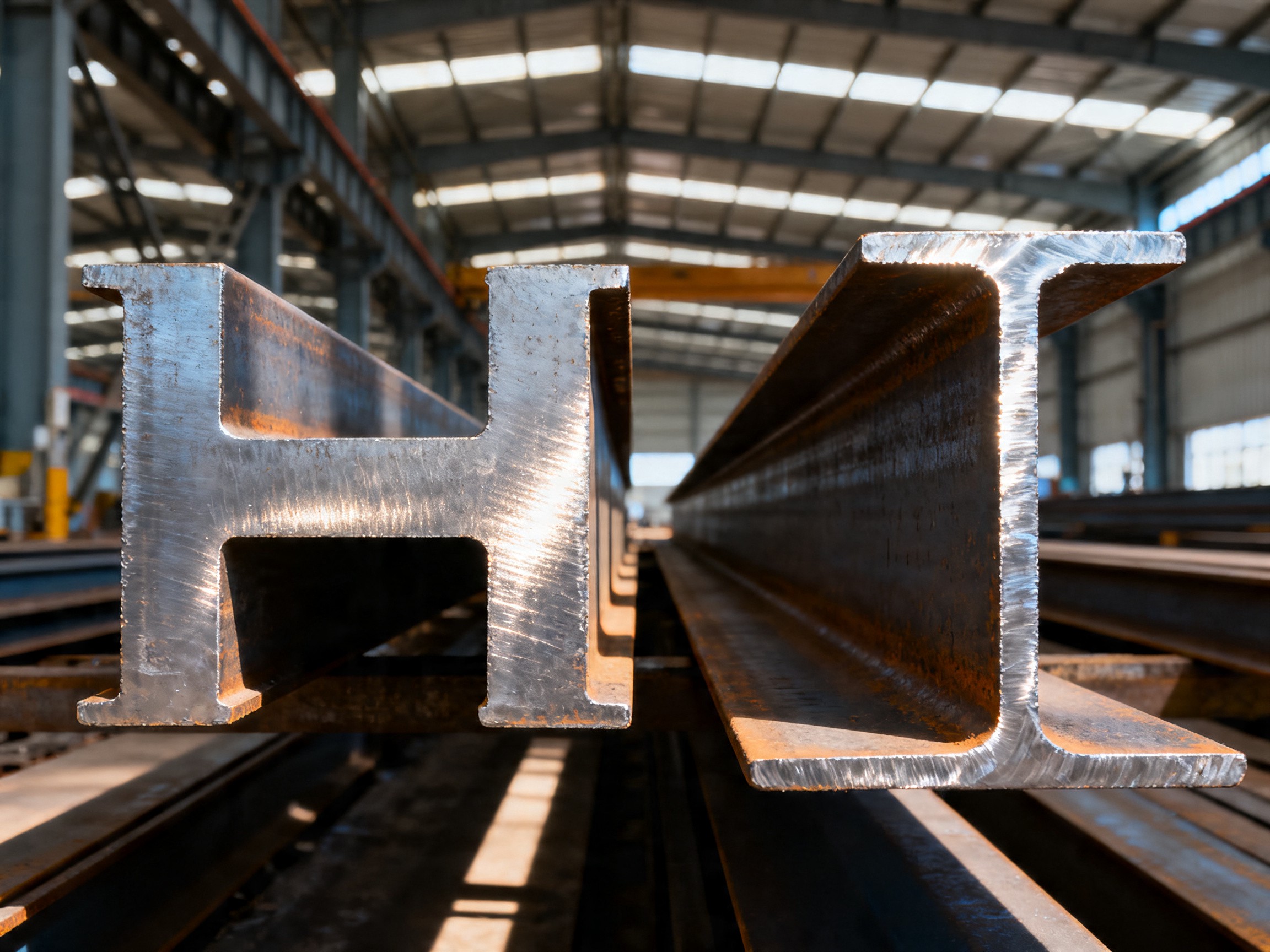
Many customers easily confuse H-beams with I-beams. Simply put, the inner and outer surfaces of the flanges of an H-beam are parallel, and the connection between the web and the flange is at a right angle, giving it a cross-sectional shape resembling the letter "H". I-beams, on the other hand, have a 1:10 slope on the inner side of the flanges, making their cross-sectional shape more like an "I", and their flange width is relatively narrower.
The advantages of H-beams are their wider flanges, higher section modulus, stronger bending resistance, and better load-bearing capacity for the same weight, making them more suitable for high-rise buildings, large-span factories, and heavy equipment foundations. I-beams are suitable for small and medium-sized structures, supports, and ordinary steel beams.
In terms of designation, American standard H-beams commonly use the "W" series, such as W8 x 10, indicating a height of 8 inches and a weight of 10 pounds per foot. Chinese standard H-beams are designated using "HW, HM, HN" followed by dimensions, such as HW200 x 200 x 8 x 12, where 200 represents the height and width, 8 represents the web thickness, and 12 represents the flange thickness. For example, I20a represents a standard I-beam with a height of 200 mm.
Navigation
- 00
0000-00
Liugang (Shandong) Supply Chain Management Co., Ltd. has secured a contract worth over US$3 million from a major Brazilian client. - 00
0000-00
Liugang (Shandong) Supply Chain Management Co., Ltd. upgrades export packaging and transportation services to help steel safely reach the world. - 00
0000-00
Basic classification and common uses of steel
MESSAGE

